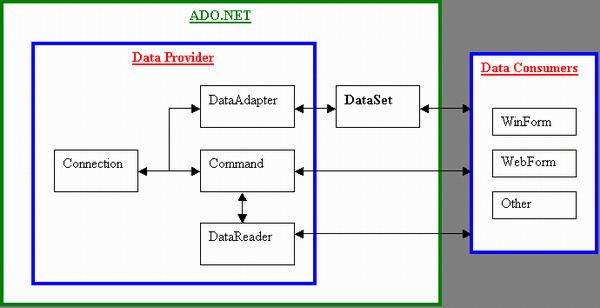
ADO.NET is an object-oriented set of libraries that allows you to interact with the data sources.
A D V E R T I S E M E N T
Commonly, any data base is the data source, but it could also be a text file, it could also be an Excel spread sheet, or an XML file. Here we will look at ADO.NET as a way to interact with a data base.
This is an simple ADO.NET database application, that returns results from the database table, writes the output to a DataGrids or TextBoxes, and uses Buttons to navigate through the records.
After getting lots of responses and suggestions from the users, I changed some points and made the code more readable. Like everyone else I also searched for a most requested method in MSDN Library to trap the keystrokes in Windows Forms and included it in the code because some users asked me desperately for that. You can find the other requested methods as well to get the contents of a cell/row in a DataGrid.
I chosed Microsoft Access database because it's easy to use and you don't need to have Microsoft SQL Server running. But ADO.NET is highly optimized if you are working with Microsoft SQL Server databases (as reflected in the ADO.NET Sql objects).
What is ADO.NET ?
ADO.NET is the new database technology of the .NET platform, and it builds on Microsoft ActiveX Data Objects (ADO). ADO is a language-neutral object model that is the keystone of Microsoft's Universal Data Access strategy.
ADO.NET is an integral part of the .NET Compact Framework, providing access to relational data, XML documents, and application data. ADO.NET supports a variety of development needs. You can create database-client applications and middle-tier business objects used by applications, tools, languages or Internet browsers.
ADO.NET defines DataSet and DataTable objects which are optimized for moving disconnected sets of data across intranets and Internets, including through firewalls. It also includes the traditional Connection and Command objects, as well as an object called a DataReader that resembles a forward-only, read-only ADO recordset. If you create a new application, your application requires some form of data access most of the time.
ADO.NET provides data access services in the Microsoft .NET platform.
You can use ADO.NET to access data by using the new .NET Framework data providers which are:
Data Provider for SQL Server (System.Data.SqlClient).
Data Provider for OLEDB (System.Data.OleDb).
Data Provider for ODBC (System.Data.Odbc).
Data Provider for Oracle (System.Data.OracleClient).
ADO.NET is a set of classes that expose data access services to the .NET developer. The ADO.NET classes are found in System.Data.dll and are integrated with the XML classes in System.Xml.dll. There are two central components of ADO.NET classes: the DataSet, and the .NET Framework Data Provider.
Data Provider is a set of components including:
The Connection object (SqlConnection,OleDbConnection,OdbcConnection,OracleConnection)
The Command object (SqlCommand,OleDbCommand, OdbcCommand,OracleCommand)
The DataReader object (SqlDataReader,OleDbDataReader, OdbcDataReader,OracleDataReader)
and The DataAdapter object (SqlDataAdapter,OleDbDataAdapter, OdbcDataAdapter,OracleDataAdapter).
Share And Enjoy:These icons link to social bookmarking sites where readers can share and discover new web pages.
Keywords:
ADO.NET introduction, introduction to ado net, introduction business letter, letter of introduction, definition of introduction, how to write a introduction, writing a introduction, how to write introduction, example of introduction, introduction letters, sas introduction, introduction letter, c++ introduction, statistics introduction