Academic Tutorials


English | French | Portugese | German | Italian
Google

Home Source Codes E-Books Downloads Contact Us About Us

HTML Tutorial
HTML Introduction
HTML Elements
HTML Basic Tags
HTML Formatting
HTML Entities
HTML Links
HTML Frames
HTML Tables
HTML Lists
HTML Forms
HTML Images
HTML Background
HTML Colors
HTML Colorvalues
HTML Colornames
HTML Quick List
HTML Layout
HTML Fonts
HTML 4.0 Why
HTML Styles
HTML Head
HTML Meta
HTML URLs
HTML Scripts
HTML Attributes
HTML Events
HTML URL-encode
HTML Webserver
HTML Summary

HTML Tutorials
HTML Tutorial
XHTML Tutorial
CSS Tutorial
TCP/IP Tutorial
XML Tutorials
XML Tutorial
XSL Tutorial
XSLT Tutorial
DTD Tutorial
Schema Tutorial
XForms Tutorial
XSL-FO Tutorial
XML DOM Tutorial
XLink Tutorial
XQuery Tutorial
XPath Tutorial
XPointer Tutorial
RDF Tutorial
SOAP Tutorial
WSDL Tutorial
RSS Tutorial
WAP Tutorial
Web Services Tutorial
Browser Scripting
JavaScript Tutorial
VBScript Tutorial
AJAX Tutorial
DHTML Tutorial
HTML DOM Tutorial
WMLScript Tutorial
E4X Tutorial
Server Scripting
ASP Tutorial
PHP Tutorial
PERL Tutorial
SQL Tutorial
ADO Tutorial
.NET (dotnet)
Microsoft.Net
XML Web Services
ASP.Net
.Net Mobile
C# : C Sharp
ADO.NET
VB.NET
Multimedia
SVG Tutorial
Flash Tutorial
Media Tutorial
SMIL Tutorial
Web Building
Web Browsers
Web Hosting
W3C Tutorial
Web Building
Web Quality
Web Semantic
Web Careers
Java Tutorials
Java Tutorial
JSP Tutorial
Servlets Tutorial
Struts Tutorial
EJB Tutorial
JMS Tutorial
JMX Tutorial
Programming Langauges
C Tutorial
C++ Tutorial
Visual Basic Tutorial
Data Structures Using C
Soft Skills
Communication Skills
Time Management
Project Management
Team Work
Leadership Skills
Corporate Communication
Negotiation Skills


HTML Elements
Previous Next

  • HTML documents are text files made up of HTML elements.
  • HTML elements are defined using HTML tags.


What Is An HTML Element
An HTML element indicates structure in an HTML document and a way of arranging content hierarchically. An HTML element is an SGML element that meets the requirements of one or more of the HTML DTDs (Document Type Definitions ). These elements have properties: both attributes and content, as specified (both allowable and required) according to the appropriate HTML DTD . Elements may represent paragraphs, headings, hypertext links, lists, embedded media, and a variety of other structures.

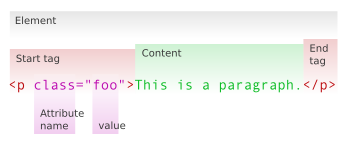
Syntactically HTML elements are constructed with:

    1) a start tag marking the beginning of an element;
    2) any number of attributes (and their associated values);
    3) some amount of content (characters and other elements)'; and
    4) an end tag.

Many HTML elements include attributes in their start tags. Attributes are defining desired behavior or indicating additional element properties. The end tag is optional for many elements. There are a few elements that are not part of any official DTDs, yet are supported by some browsers and used by some web pages. Such elements may be ignored or displayed improperly on browsers not supporting them.


HTML Tags

Informally, HTML elements are sometimes referred to as "tags", though many prefer the term tag strictly in reference to the semantic structures delimiting the start and end of an element.

  • HTML tags are used to mark-up HTML elements
  • HTML tags are surrounded by the two characters < and >
  • The surrounding characters are called angle brackets
  • HTML tags normally come in pairs like <i> and </i>
  • The first tag in a pair is the start tag(<i>), the second tag is the end tag(</i>)
  • The element content is the text between the start and end tags
  • HTML tags are not case sensitive, <b> means the same as <B>


  • Why do We Use Lowercase Tags?
    Start using lowercase tags, if you want to prepare yourself for the next generations of HTML. The World Wide Web Consortium (W3C) recommends lowercase tags in their HTML 4 recommendation, and XHTML - the next generation HTML - demands lowercase tags.


    Share And Enjoy:These icons link to social bookmarking sites where readers can share and discover new web pages.
    • blinkbits
    • BlinkList
    • blogmarks
    • co.mments
    • connotea
    • del.icio.us
    • De.lirio.us
    • digg
    • Fark
    • feedmelinks
    • Furl
    • LinkaGoGo
    • Ma.gnolia
    • NewsVine
    • Netvouz
    • RawSugar
    • Reddit
    • scuttle
    • Shadows
    • Simpy
    • Smarking
    • Spurl
    • TailRank
    • Wists
    • YahooMyWeb

    Previous Next

    Keywords:html form elements, html document, html tags, html elements attribute


    HTML Quizes
    HTML Quiz
    XHTML Quiz
    CSS Quiz
    TCP/IP Quiz
    XML Quizes
    XML Quiz
    XSL Quiz
    XSLT Quiz
    DTD Quiz
    Schema Quiz
    XForms Quiz
    XSL-FO Quiz
    XML DOM Quiz
    XLink Quiz
    XQuery Quiz
    XPath Quiz
    XPointer Quiz
    RDF Quiz
    SOAP Quiz
    WSDL Quiz
    RSS Quiz
    WAP Quiz
    Web Services Quiz
    Browser Scripting Quizes
    JavaScript Quiz
    VBScript Quiz
    AJAX Quiz
    DHTML Quiz
    HTML DOM Quiz
    WMLScript Quiz
    E4X Quiz
    Server Scripting Quizes
    ASP Quiz
    PHP Quiz
    PERL Quiz
    SQL Quiz
    ADO Quiz
    .NET (dotnet) Quizes
    Microsoft.Net Quiz
    XML Web Services Quiz
    ASP.Net Quiz
    .Net Mobile Quiz
    C# : C Sharp Quiz
    ADO.NET Quiz
    VB.NET Quiz
    Multimedia Quizes
    SVG Quiz
    Flash Quiz
    Media Quiz
    SMIL Quiz
    Web Building  Quizes
    Web Browsers Quiz
    Web Hosting Quiz
    W3C Quiz
    Web Building Quiz
    Web Quality Quiz
    Web Semantic Quiz
    Web Careers Quiz
    Java Quizes
    Java Quiz
    JSP Quiz
    Servlets Quiz
    Struts Quiz
    EJB Quiz
    JMS Quiz
    JMX Quiz
    Programming Langauges Quizes
    C Quiz
    C++ Quiz
    Visual Basic Quiz
    Data Structures Using C Quiz
    Soft Skills Quizes
    Communication Skills Quiz
    Time Management Quiz
    Project Management Quiz
    Team Work Quiz
    Leadership Skills Quiz
    Corporate Communication Quiz
    Negotiation Skills Quiz

    Privacy Policy
    Copyright © 2003-2008 Vyom Technosoft Pvt. Ltd., All Rights Reserved.