Academic Tutorials


English | French | Portugese | German | Italian
Google

Home Source Codes E-Books Downloads Contact Us About Us

Data Structures Using C
Introduction to Data Structures
Pointers and Indirection
Linear Data Structures
Stacks: The Abstract View
Queues: The Abstract View
Introduction to Trees
Introduction to Graphs

HTML Tutorials
HTML Tutorial
XHTML Tutorial
CSS Tutorial
TCP/IP Tutorial
XML Tutorials
XML Tutorial
XSL Tutorial
XSLT Tutorial
DTD Tutorial
Schema Tutorial
XForms Tutorial
XSL-FO Tutorial
XML DOM Tutorial
XLink Tutorial
XQuery Tutorial
XPath Tutorial
XPointer Tutorial
RDF Tutorial
SOAP Tutorial
WSDL Tutorial
RSS Tutorial
WAP Tutorial
Web Services Tutorial
Browser Scripting
JavaScript Tutorial
VBScript Tutorial
AJAX Tutorial
DHTML Tutorial
HTML DOM Tutorial
WMLScript Tutorial
E4X Tutorial
Server Scripting
ASP Tutorial
PHP Tutorial
PERL Tutorial
SQL Tutorial
ADO Tutorial
.NET (dotnet)
Microsoft.Net
XML Web Services
ASP.Net
.Net Mobile
C# : C Sharp
ADO.NET
VB.NET
Multimedia
SVG Tutorial
Flash Tutorial
Media Tutorial
SMIL Tutorial
Web Building
Web Browsers
Web Hosting
W3C Tutorial
Web Building
Web Quality
Web Semantic
Web Careers
Java Tutorials
Java Tutorial
JSP Tutorial
Servlets Tutorial
Struts Tutorial
EJB Tutorial
JMS Tutorial
JMX Tutorial
Programming Langauges
C Tutorial
C++ Tutorial
Visual Basic Tutorial
Data Structures Using C
Soft Skills
Communication Skills
Time Management
Project Management
Team Work
Leadership Skills
Corporate Communication
Negotiation Skills


Trees: The Abstract View

Previous Next


Trees: The Abstract View
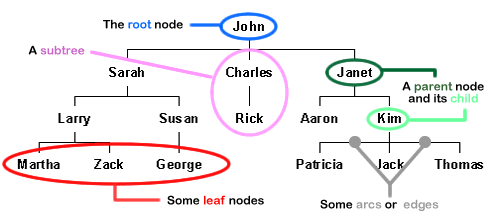
Another common nonlinear data structure is the tree.


In this diagram above, we can see that the starting point, or the root node, is circled in blue colour. A node is a simple structure that holds data and links to other nodes. In this case, our root node contains the data string "John" and three links to the other nodes. Notice that the group of nodes circled in red do not have any links(childs). These nodes are at the end of the branches and they are appropriately called as leaves or leaf nodes. In our diagram, the nodes are interconnected with solid black lines called arcs or edges. These edges show the relationships between the nodes in the tree.

One important relationship in the binary tree is the parent-child relationship. Parent nodes have at least one edge to the node lower in the tree. This lower node is called the child node. Nodes can have more than one child, but the children can only have a single parent. Notice that the root node has no parent, and the leaf nodes has no children. Final feature to note in our diagram is the subtree. At each level of the tree, we can see that the tree structure is repeated. For example, the two nodes representing "Charles" and "Rick" compose a very simple tree with "Charles" as the root node and and "Rick" as a single leaf node.

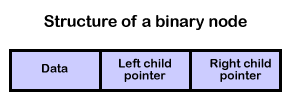
Trees are implemented in the computer's memory. We will begin by introducing the simple tree structure called the binary tree. Binary trees have the restriction that nodes can't have more than two children. With this restriction, we can easily determine how to represent a single binary node in the memory. Our node will need to reserve memory for the data and two pointers(for pointing two childs of that node).


Structure of a binary node:

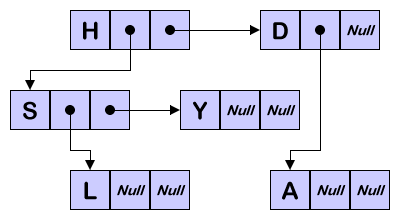
Using our binary nodes, we can construct a binary tree. In the data cell of each node, we will can store a letter. The physical representation of our tree might look something like the figure below:


Share And Enjoy:These icons link to social bookmarking sites where readers can share and discover new web pages.
  • blinkbits
  • BlinkList
  • blogmarks
  • co.mments
  • connotea
  • del.icio.us
  • De.lirio.us
  • digg
  • Fark
  • feedmelinks
  • Furl
  • LinkaGoGo
  • Ma.gnolia
  • NewsVine
  • Netvouz
  • RawSugar
  • Reddit
  • scuttle
  • Shadows
  • Simpy
  • Smarking
  • Spurl
  • TailRank
  • Wists
  • YahooMyWeb

Previous Next

Keywords: Tree programming, trees c++, tree c++, tree programming, binary tree c++, binary search tree c++, trees in c++, trees data structures, source code programming, programming data structures, trees tutorial, identification trees, recursion programming, trees algorithms


HTML Quizes
HTML Quiz
XHTML Quiz
CSS Quiz
TCP/IP Quiz
XML Quizes
XML Quiz
XSL Quiz
XSLT Quiz
DTD Quiz
Schema Quiz
XForms Quiz
XSL-FO Quiz
XML DOM Quiz
XLink Quiz
XQuery Quiz
XPath Quiz
XPointer Quiz
RDF Quiz
SOAP Quiz
WSDL Quiz
RSS Quiz
WAP Quiz
Web Services Quiz
Browser Scripting Quizes
JavaScript Quiz
VBScript Quiz
AJAX Quiz
DHTML Quiz
HTML DOM Quiz
WMLScript Quiz
E4X Quiz
Server Scripting Quizes
ASP Quiz
PHP Quiz
PERL Quiz
SQL Quiz
ADO Quiz
.NET (dotnet) Quizes
Microsoft.Net Quiz
XML Web Services Quiz
ASP.Net Quiz
.Net Mobile Quiz
C# : C Sharp Quiz
ADO.NET Quiz
VB.NET Quiz
Multimedia Quizes
SVG Quiz
Flash Quiz
Media Quiz
SMIL Quiz
Web Building  Quizes
Web Browsers Quiz
Web Hosting Quiz
W3C Quiz
Web Building Quiz
Web Quality Quiz
Web Semantic Quiz
Web Careers Quiz
Java Quizes
Java Quiz
JSP Quiz
Servlets Quiz
Struts Quiz
EJB Quiz
JMS Quiz
JMX Quiz
Programming Langauges Quizes
C Quiz
C++ Quiz
Visual Basic Quiz
Data Structures Using C Quiz
Soft Skills Quizes
Communication Skills Quiz
Time Management Quiz
Project Management Quiz
Team Work Quiz
Leadership Skills Quiz
Corporate Communication Quiz
Negotiation Skills Quiz

Privacy Policy
Copyright © 2003-2008 Vyom Technosoft Pvt. Ltd., All Rights Reserved.